
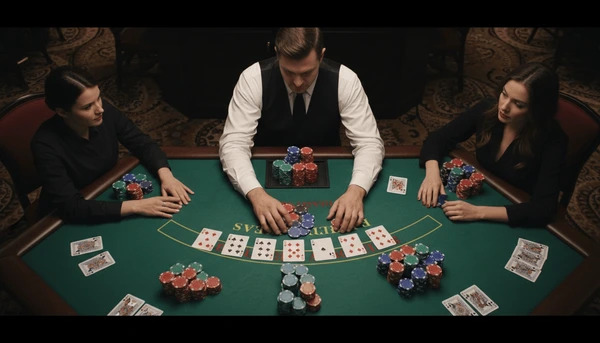
Casinos are carefully designed environments built on structure, probability, and control. Every game follows strict rules, and every outcome is meant to fall within a system that ensures fairness while maintaining a small advantage for the house.
Players walk in hoping for luck. Casinos rely on mathematics and discipline to stay profitable.
But over the years, there have been moments when individuals tried to disrupt that balance.
Some used simple tricks. Others relied on teamwork. A few turned to technology in surprisingly advanced ways. These stories may sound like fiction, but many of them are well documented and reveal an ongoing battle between those trying to exploit the system and those working to protect it.
At the same time, these incidents pushed casinos to evolve, becoming more secure and more observant with each challenge.
Early Methods: Simple but Risky
In earlier decades, casino cheating often relied on basic human coordination.
Players would sometimes work in teams. One person might distract the dealer while another manipulated chips or attempted to influence the game in subtle ways. These actions required timing and confidence, but they were not always effective.
Another common method was card marking.
Players would place tiny, nearly invisible marks on cards to identify their values later. Even a slight edge—knowing whether a high card was coming—could influence decisions.
There were also cases of past posting, where a player would attempt to add or change a bet after the outcome was already known. While difficult to execute, it occasionally succeeded in poorly monitored environments.
At the time, surveillance systems were limited, making these techniques more viable than they would be today.
Famous Real-World Cases
As casinos became more sophisticated, so did the people attempting to cheat them.
The MIT Blackjack Team
Although not illegal, the MIT Blackjack Team used advanced card counting and teamwork to gain a mathematical edge over casinos.
- Estimated profits: $50,000 to $100,000 per week at peak
- Strategy: team-based counting and coordinated betting
Casinos eventually responded by:
- Increasing surveillance
- Banning suspected players
- Changing game conditions (more decks, frequent shuffling)
This case showed that even legal advantage play could trigger defensive action.
Richard Marcus and Chip Manipulation
Richard Marcus became known for exploiting dealer blind spots.
His technique involved:
- Placing high-value chips after the outcome was clear
- Using sleight of hand to swap chips unnoticed
He reportedly made millions of dollars before casinos identified his methods.
Phil Ivey and Edge Sorting
One of the most debated cases involved Phil Ivey and a technique called edge sorting in baccarat.
- Winnings: approximately $10 million
- Method: identifying tiny asymmetries on card backs
Casinos later challenged these winnings in court, arguing that it violated game integrity. The courts ruled in favor of the casino, and the winnings were not paid.
This case blurred the line between skill and cheating.
Technology Enters the Game
By the late 20th century, cheating methods began to involve technology.
Some individuals used:
- Hidden computers to calculate probabilities
- Small devices to predict roulette outcomes
- Communication tools to coordinate actions
One notable example involved players using early computers to predict roulette wheel patterns.
The Mathematics Behind Roulette Prediction
Each number in European roulette has an equal probability, making prediction extremely difficult without physical bias.
Despite this randomness, some players attempted to exploit physical imperfections in wheels or dealer habits. While rare, even small biases could create a slight advantage.
However, such opportunities were short-lived.

How Casinos Fought Back
Casinos responded to cheating not with a single solution, but with layered defenses.
1. Advanced Surveillance Systems
Modern casinos use extensive camera networks, often referred to as the “eye in the sky.”
- Hundreds to thousands of cameras per property
- Facial recognition technology in some locations
- Real-time monitoring teams
Every table, machine, and movement is observed.
2. Data Tracking and Analytics
Casinos now track:
- Betting patterns
- Player behavior
- Game outcomes
Unusual activity can trigger alerts automatically.
For example:
- Sudden large bets after small bets
- Repeated patterns across multiple tables
These systems allow casinos to detect anomalies quickly.
3. Game Design Changes
To reduce vulnerabilities, casinos modified games:
- Multi-deck blackjack instead of single-deck
- Automatic shuffling machines
- Frequent card changes
- Improved roulette wheel calibration
These changes reduced the effectiveness of traditional cheating methods.
4. Staff Training
Dealers and pit bosses are trained to notice:
- Suspicious hand movements
- Player coordination signals
- Irregular betting behavior
Human observation remains a critical layer of defense.

The Scale of Casino Security Today
Modern casinos invest heavily in security.
- Large casinos may spend millions of dollars annually on surveillance systems
- Detection rates for cheating attempts have increased significantly
- Most cheating schemes are now identified quickly
In many cases, suspected individuals are:
- Asked to leave
- Banned from properties
- Reported to shared industry databases
A Balanced Perspective
While these stories are fascinating, they also highlight an important reality.
Cheating is not a sustainable strategy.
Even when someone succeeds temporarily, the system eventually adapts. Casinos continuously learn from past incidents, strengthening their defenses over time.
The relationship between cheating and security is almost like an ongoing cycle:
- A new method appears
- Casinos identify it
- Systems improve
- The method becomes ineffective
What These Stories Teach Us
These real-world examples are not just about clever tricks. They are about how systems evolve under pressure.
They show that:
- Even complex systems can have weaknesses
- Those weaknesses are often temporary
- Long-term stability comes from adaptation
For players, there is also a clear takeaway.
Casino games are designed with built-in advantages. Trying to bypass those systems rarely leads to lasting success.
Final Thoughts
The history of casino cheating is filled with creativity, risk, and unexpected outcomes. From simple card marking to advanced technological attempts, people have explored many ways to challenge the system.
But what stands out even more is how casinos responded.
They adapted, improved, and built stronger systems with each challenge. Today’s casinos are far more secure, not because cheating disappeared, but because it forced innovation.
In the end, these stories are not just about breaking rules. They are about how systems defend themselves and grow stronger over time.
When you walk into a casino today, the experience may feel simple on the surface. Lights, games, and excitement.
But behind it all is a complex structure—one that is always watching, always learning, and always evolving.